 The EUREQA dataset
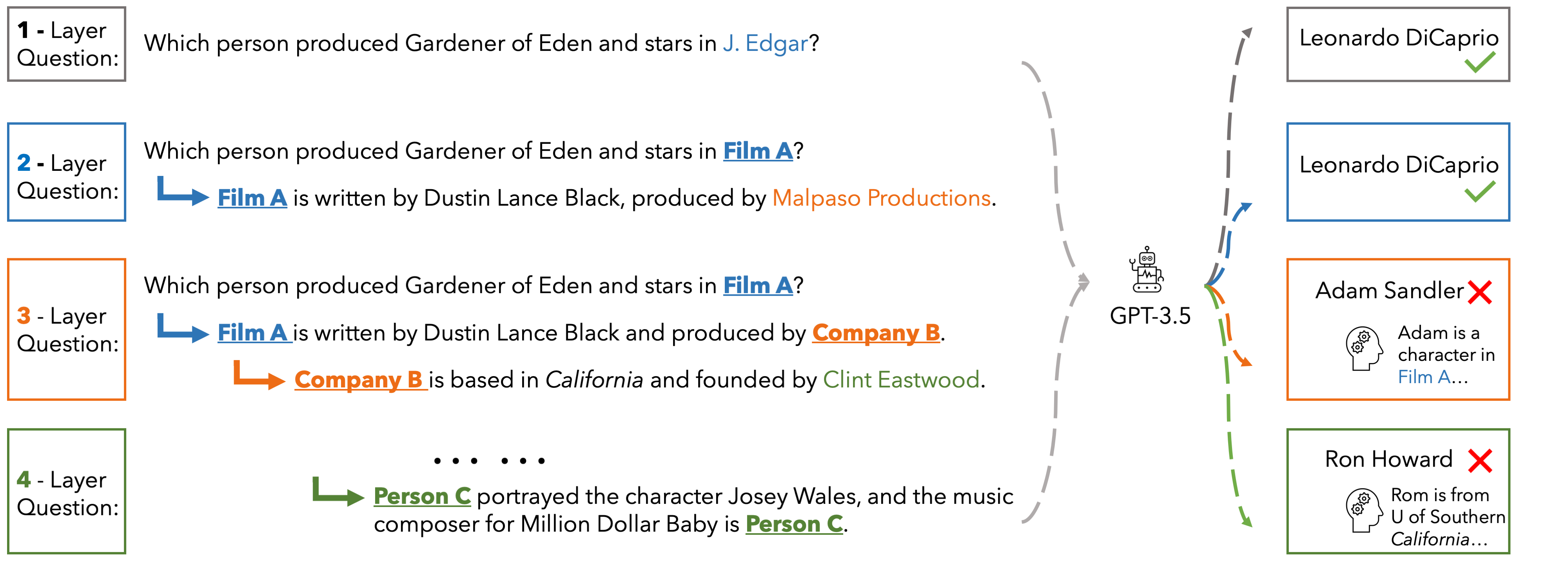
In EUREQA, every question is constructed through an implicit reasoning chain. The chain is constructed by parsing DBPedia. Each layer comprises three components: an entity, a fact about the entity, and a relation between the entity
and its counterpart from the next layer. The layers stack up to create chains with different depths of reasoning. We verbalize reasoning chains into natural sentences and anonymize the entity of each layer to create the question.
Questions can be solved layer by layer and each layer is guaranteed a unique answer. EUREQA is not a knowledge game: we adopt a knowledge filtering process that ensures that most LLMs have sufficient world knowledge to answer our questions.
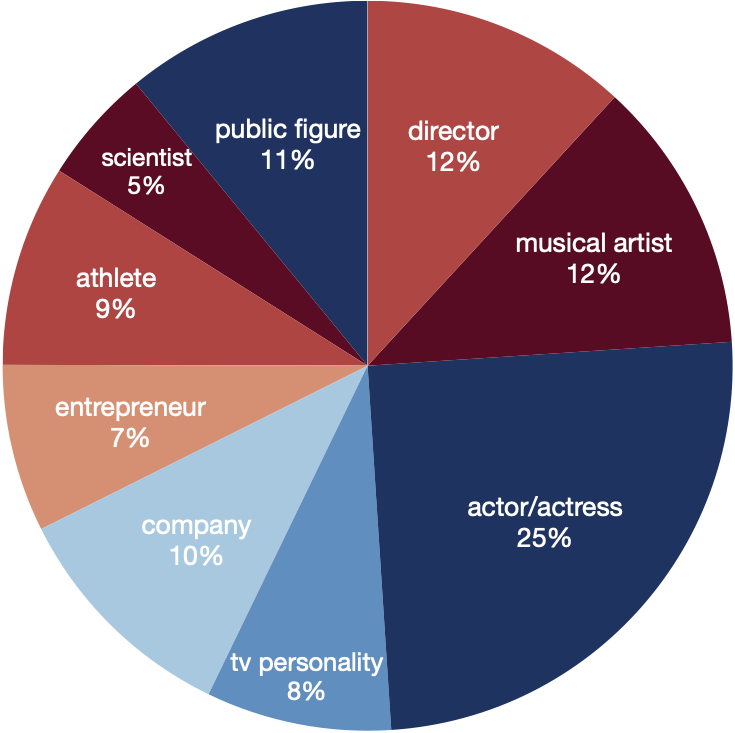
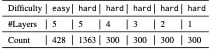
EUREQA comprises a total of 2,991 questions of different reasoning depths and difficulties. The entities encompass a broad spectrum of topics, effectively reducing any potential bias arising from specific entity categories.
These data are great for analyzing the reasoning processes of LLMs
Programs like Hamilton Thorne or Microptic Medilab.
The incredible precision of a "sperm photo editor" is powered by —a type of AI modeled after the neural networks of the human brain. Just like a person learns to identify cars, a sperm analysis AI "learns" by being trained on thousands of pre-labeled images and videos of sperm. For example, a deep learning model called YOLOv5s (You Only Look Once) can scan an image and, in a single pass, identify and locate every sperm cell within it. This training allows the AI to identify and classify cells with a level of consistency and detail impossible for a human technician, making the analysis more objective and reproducible.
At first glance, the phrase "sperm photo editor" might sound like a joke or a hyper-specific Instagram filter. In reality, it is a serious, technically demanding job that sits at the intersection of medical biology, graphic design, and data analysis. Without these specialists, fertility doctors would struggle to diagnose male factor infertility, and patients would have a much harder time understanding their treatment options.
Let’s debunk three widespread misconceptions.
 Analyses and discussion
Programs like Hamilton Thorne or Microptic Medilab.
The incredible precision of a "sperm photo editor" is powered by —a type of AI modeled after the neural networks of the human brain. Just like a person learns to identify cars, a sperm analysis AI "learns" by being trained on thousands of pre-labeled images and videos of sperm. For example, a deep learning model called YOLOv5s (You Only Look Once) can scan an image and, in a single pass, identify and locate every sperm cell within it. This training allows the AI to identify and classify cells with a level of consistency and detail impossible for a human technician, making the analysis more objective and reproducible.
At first glance, the phrase "sperm photo editor" might sound like a joke or a hyper-specific Instagram filter. In reality, it is a serious, technically demanding job that sits at the intersection of medical biology, graphic design, and data analysis. Without these specialists, fertility doctors would struggle to diagnose male factor infertility, and patients would have a much harder time understanding their treatment options.
Let’s debunk three widespread misconceptions.
This website is adapted from Nerfies, UniversalNER and LLaVA, licensed under a Creative Commons Attribution-ShareAlike 4.0 International License. We thank the LLaMA team for giving us access to their models.
Usage and License Notices: The data abd code is intended and licensed for research use only. They are also restricted to uses that follow the license agreement of LLaMA, ChatGPT, and the original dataset used in the benchmark. The dataset is CC BY NC 4.0 (allowing only non-commercial use) and models trained using the dataset should not be used outside of research purposes.